

Beneficial effects of astaxanthin on brain health

 7 MIN
7 MIN  ALMAGEA
  16.01.2024
7 MIN ALMAGEA 16.01.2024
Due to the increase in life expectancy in almost all developed countries, more and more people are starting to worry about brain health, preservation of vision and cognitive functions, and there is a growing interest in preventive ways of preserving mental health in advanced age (1).
Oxidative stress is defined as a lack of balance between the appearance of reactive forms of oxygen and nitrogen, i.e. free radicals, and the ability of the organism to suppress their action with antioxidant protection systems (2). Reactive forms of oxygen and nitrogen lead to the creation of oxidative stress, which causes damage to various tissues. Since brain tissue has a high content of polyunsaturated fatty acids, it is particularly sensitive to the negative influence of free radicals (3).
Vitamin E plays a role in preserving cell membranes from free radical damage by fighting lipid peroxidation of cell membranes (2). Selenium, in synergy with vitamin E, also has an antioxidant effect, acting as an important intracellular antioxidant in preventing oxidative damage (4).
The carotenoid astaxanthin can be found in nature in certain plants, animals and algae. This powerful antioxidant is obtained from a type of microalgae Haematococcus pluvialis.It is interesting due to its antioxidant, anti-inflammatory and cardioprotective properties, due to its protective effect on eye health, modulation of the immune system and neuroprotective activities (1).
It is known that astaxanthin, one of the strongest antioxidants in nature (up to 500 times stronger than vitamin E), has a beneficial effect on the skin, heart and joint pain. Namely, the latest research shows that astaxanthin also has a strong protective effect on the human brain because, due to its unique chemical structure, it simply passes through the blood-brain barrier (5). It has been shown that in this way astaxanthin can reduce depression and stress in healthy subjects, as well as improve memory in people with impaired cognitive functions (6).
A clinical study conducted by Talbott et al focused on various parameters of mental health. 28 healthy, active, adult respondents who were not diagnosed with depression, aged 26 to 63, participated in the study. During 8 weeks, one group took astaxanthin, while the control group took a placebo. The food supplement contained a microalgae extract Haematococcus pluvialis which contains 12 mg of astaxanthin and is combined with oil of medium-chain fatty acids and a small amount of D-α tocopherol in order to maintain the stability of the capsule composition (1). At the end of the study, the scientists observed significant improvements in certain parameters of mental health, including feelings of depression, fatigue and mood.The researchers reported that:
Scientists came to this conclusion using the results of a study collected on healthy subjects using a questionnaire about their feelings of depression. The questionnaire contained subjective questions about their symptoms of depression, which can also occur in people who do not have a clinical diagnosis of depression. The authors of the study report that improvements in other important mental health parameters such as tension, anger and confusion were also observed (1).
Furthermore, in their study, Sekikawa et al examined the cognitive health of participants in a randomized, double-blind, placebo-controlled study.All subjects were healthy adults with mild forgetfulness and were divided into two groups. One group took 9 mg of astaxanthin extract obtained from microalgae species Haematococcus pluvialis, while another took safflower oil in tablet form as a placebo (6). After 12 weeks of taking astaxanthin, there was a statistically significant improvement compared to the placebo group after tests of cognitive function and memory. Verbal and complex memory improved significantly, as tested by a computer system used to monitor and measure brain function. Complex memory improved by 22.3%, while improvement in reasoning increased by as much as 48.2% and subjective symptoms improved by 25%, after 12 weeks of taking astaxanthin (6).
Literature:
1. Talbott, S., Hantla, D., Capelli, B., Ding, L., Li, Y., Artaria, C. (2019) Astaxanthin Supplementation Reduces Depression and Fatigue in Healthy Subjects. EC Nutrition. 14(3), 239-246.
2. Pisoschi, A. M., Pop, A. (2015) The role of antioxidants in the chemistry of oxidative stress: A review. Eur. J. Med. Chem.97, 55–74.
3. Uttara, B., Singh, A., Zamboni, P., Mahajan, R. (2009) Oxidative Stress and Neurodegenerative Diseases: A Review of Upstream and Downstream Antioxidant Therapeutic Options. Curr. Neuropharmacol, 7(1), 65–74.
4.Wang, N., Tan, H.-Y., Li, S., Xu, Y., Guo, W., Feng, Y. (2017) Supplementation of Micronutrient Selenium in Metabolic Diseases: Its Role as an Antioxidant. Oxid. Honey. Cell. Longev.2017, 1–13.
5. Galasso, C., Orefice, I., Pellone, P., Cirino, P., Miele, R., Ianora, A., Brunet, C., Sansone, C. (2018) On the Neuroprotective Role of Astaxanthin: New Perspectives? Mar. Drugs.16(8), 247.
6. SekikawaT., Kizawa Y., Li Y., Takara T. (2019) Cognitive Function Improvement with Astaxanthin Intake: A Randomized, Double-Blind, Placebo-Controlled Study. Pharmacometric. 97 (1/2), 1-13.
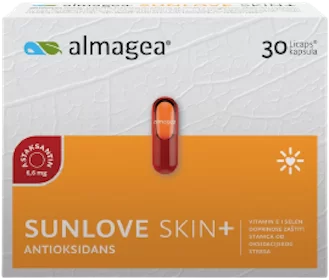
Skin care from the inside all year round and protection against oxidative stress.
23.98 €


Get to know us
Dietary supplements
Information
Let's connect
© 2024. Almagea d.o.o., Ulica Julija Knifera 4, 10 020 Zagreb
Fixed conversion rate: €1 = HRK 7.5345
buy quickly and safely